Seasoned content marketers understand the concept of topic clusters — creating content around a central theme supported by offshoot pages that relate to the topic. It’s a tried-and-true SEO tactic that inherently creates better user experiences, defines website taxonomy, and allows search engines to crawl and index website content.
The question today, in the evolving age of LLMs and generative AI, is: Do topic clusters still matter in an AI-first search?
The short answer is: Topic clusters aren’t dead, but they have evolved in their purpose, impact, and in the way they’re used. First, a quick refresher on what topic clusters are, followed by how AI has changed the way people search and, therefore, the way topic clusters benefit generative search results.
What Are Topic Clusters? (Quick Refresher)
Topic clusters describe a content ideation and creation model that groups content around a central pillar or theme, surrounded by interlinking relevant and supporting subtopics.
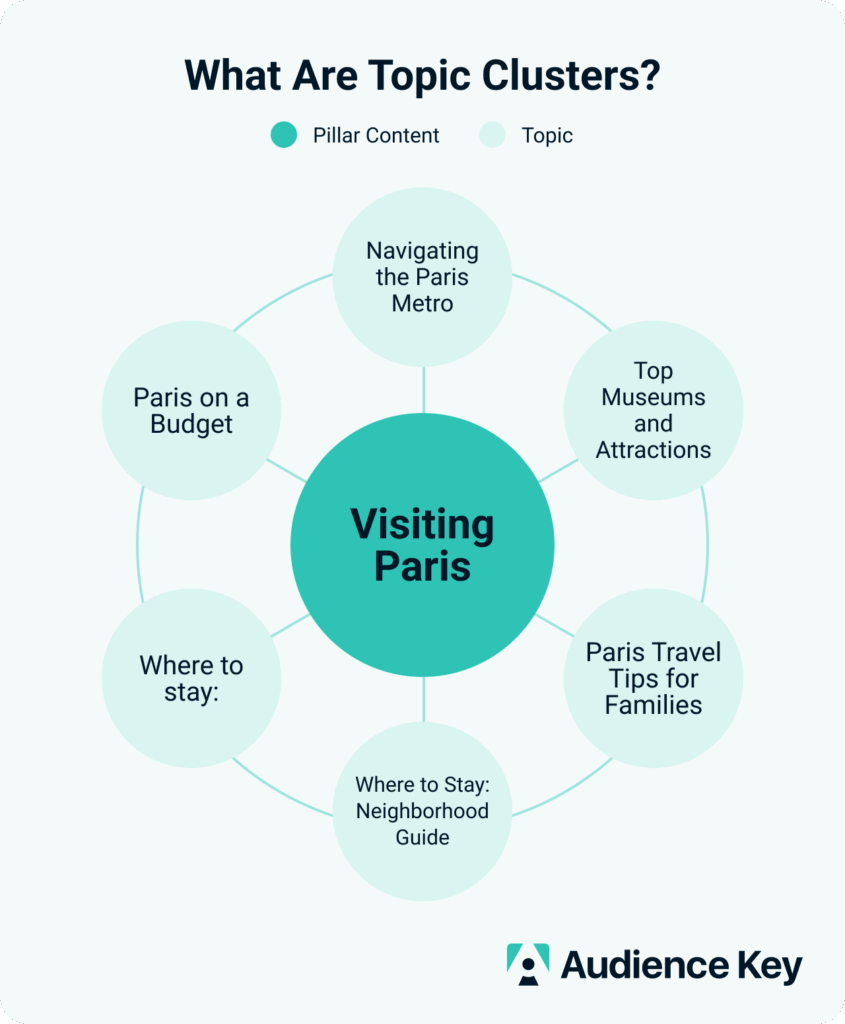
Think of topic clusters like a travel guide. The cluster in this example is visiting Paris, and the supporting or subordinate content includes neighborhood directories, budget travel tips, hotel and transportation information, and sections on museums and attractions. Taking it a step further, in the digital world, topic clusters not only topically relate to one another, but the pages internally link to each other, to show a relationship among the pages.
You could also use grocery stores, libraries, or warehouses to analogize topic clusters: Our brains are wired to seek information logically, and search engines and large language models (LLMs), mimic human behaviors. Search engines are engineered based on historical data to predict user intent, while LLMs are built to interpret queries (language) in the moment.
Are Topic Clusters Still Relevant?
So, yes, topic clusters organize your content so it’s intuitive to navigate not only for search engines but also for real people and, now, for AI because they:
- Establish topical authority
- Enhance your site structure
- Simplify your site’s navigation
- Offer better user experiences
Topic Cluster Examples
Let’s continue with travel to Paris as an example of topic clusters. Your main destination is your pillar page — Visiting Paris. The supporting pages offer categories for trip planning, and some of those supporting pages have subordinate pages, like this:
- /visit-paris/transportation/: Navigating Paris: Getting Around by Trains, Buses, Taxis and Uber
- /visit-paris/museums/: Paris Museums: 20 Must-See Museums Ranked by Popularity
- /visit-paris/museums/louvre/: The Louvre in One Day
- /visit-paris/museums/small-museums/: 5 Little-Known Museums in Paris
- /visit-paris/neighborhood-guide/: Paris’s 20 Arrondissements and What They’re Known For
- /visit-paris/neighborhood-guide/louvre
- /visit-paris/neighborhood-guide/elysee
- /visit-paris/neighborhood-guide/luxembourg
- /visit-paris/neighborhood-guide/butte-montmartre
That kind of mapped, interconnected layout doesn’t just help travelers, it signals to search and AI systems that you cover the topic end to end.
Why Topic Clusters Still Matter in the AI Era
We know that AI assistants prefer sources that demonstrate comprehensive understanding about a topic. In fact, much of the early research into how AI tools choose their sources suggests that AI engines gravitate toward content from well-established sites. A Search Engine Land analysis of data gathered via Rankscale.ai suggests:
- ChatGPT favors Wikipedia, news sites and blogs
- Gemini likes YouTube (another Google product), blogs and news sites
- Perplexity prefers blogs, news and expert review sites
- Google AI Overviews tend to mirror its organic search results
However, rather than performing like a search engine, which crawls sources based on keywords and semantic variations, it uses natural language processing and natural language understanding to interpret queries. In other words, AI assistants try to deconstruct queries to extract meaning. To deliver answers, it leverages vast knowledge from various sources and its own “learnings” based on interactions with millions of users, to deliver the most relevant information.
In short: Like search engines, AI favors quality content covered from many angles by credible sources; therefore, topic clusters matter in the AI era.
How the Rise of AI Changed Search Behavior
Generative AI (ChatGPT, Google AI Overviews, Bing Copilot, Perplexity) has shifted search behavior from “finding pages” to “getting synthesized answers.” Users are asking longer, multi-step conversational queries (“plan a 3-day Paris trip near Montmartre with a toddler”), and users expect a synthesized, attributed answer often without clicking. They mix intents (learn, compare, decide) in one thread and follow up (“what about museums open Monday?”). That shift favors sources that organize a topic comprehensively and make relationships easy for machines to parse.
A well-built cluster gives them a ready-made map: one pillar that frames the topic, supporting pages that cover common intents, and internal links that spell out how ideas relate. With consistent titles, schema, and terminology, those relationships become machine-readable, making it easier for retrieval models to pull accurate snippets and attribute them. In short, clusters turn your site into the one-stop source AI can cite with confidence, setting up the playbook below.
Why this sets up topic clusters
- Breadth = coverage of subtopics/intents. Map the topic’s entity graph (the real world things in your topic, such as people, products, processes, places), then plan pages that address each facet (how-to, comparison, troubleshooting, definitions, FAQs).
- Relationships = internal link graph. Use pillar → hub → leaf architecture with descriptive anchors so the model “sees” how pieces fit. Cross-link sibling pages where users (and embeddings) expect it.
- Consistency = signals that reinforce meaning. Align titles, H-tags, schema (e.g., Article, Product, FAQ), and on-page entities so the cluster reads as one coherent knowledge unit.
- Depth beats density. First-hand details, data, images, and step-by-step experience expand the vector footprint beyond a single term, strengthening perceived expertise.
Avoid Pitfalls With Topic Clusters
Best practices for AI clustering strategies are much the same as they are for SEO content strategies:
- Favor quality over a formulaic quantity: Don’t treat topic clusters as a rigid “one pillar + X subpages” content strategy formula.
- Prioritize your audience over technology: Don’t create clusters only for search engines or AI tools. Don’t ignore human readability and usefulness.
- Prioritize depth over volume: Avoid covering too many shallow subtopics, diluting authority rather than strengthening it. Fewer stronger clusters are better than many weak ones.
- Start with intent, then keywords: Map clusters to user journeys and questions.
- Leverage internal linking smartly: Keep navigation natural, not forced.
- Refresh clusters regularly: Iterate on your topic clusters. AI systems value recency and completeness.
Future of Topic Clusters in AI Search
To answer the question, “Will topic clusters be relevant in 5 years or even a year from now,” I turn to the guy I always turn to for questions like this, Shay Clark, our technical SEO expert.
Shay says the reason clusters have always worked is simple: They make sense to people. Humans process information best when it’s organized around clear hubs and related subtopics. That structure helps both users and traditional algorithms measure relevance, engagement, and trust.
He also points out that machines don’t think like we do, and they won’t keep favoring the same organization methods forever. He notes that we’re already seeing this shift in how backlinks are evaluated. The value of a link is no longer based only on its source but also on the meaning and intent of the content around it. Search systems are moving from scoring relationships between sites to understanding the relationships between ideas.
That same evolution is coming for topic clusters. As search becomes more conversational and results blend into synthesized answers, the visible benefit of clusters will matter less to machines and more to humans. Shay says topic clusters will “stick around as long as traditional search does,” because they still influence human metrics such as clicks, dwell time, and comprehension. But as we move further into AI-driven interfaces like voice, chat, and embedded assistants, those signals may fade.
Eventually, clusters may evolve into something broader: multimodal structures that let users and systems experience a topic through text, video, audio, or interactive formats — different “modes” of the same knowledge. The name may change, but the goal stays the same: to organize ideas in a way that makes meaning easier to find and use.