You chose Shopify because it let you move fast.
You launched quickly. You added products without friction. You didn’t need a dev team to keep the store running. For a long time, that tradeoff felt right.
Then growth slowed in places you couldn’t quite explain.
Products were indexed. Categories existed. Content was published. SEO basics were covered. Yet competitors started showing up more often in product grids. Similar products appeared in search results where yours didn’t. Incremental improvements stopped producing incremental gains.
What changed wasn’t effort. It was how search systems decide what to surface.
Modern search and AI-driven shopping experiences rely less on individual pages and more on understanding relationships. They need to know how products connect to categories, how categories roll up into broader themes, and how attributes refine intent without fragmenting it.
That understanding does not come from product copy alone. It comes from structure.
When structure is shallow, implied, or flattened by the platform, visibility suffers quietly. Not because anything is broken, but because meaning is harder to establish than it should be.
This is where many Shopify stores find themselves today. Not failing. Just capped.
The rest of this article explains why that ceiling exists, how Shopify’s category model contributes to it, and what changes when layered structure is added back into the equation without replacing the platform you are already running.
Why Ecommerce SEO Now Runs on Structure, Not Just Content
Organic ecommerce search no longer behaves like a list of blue links.
For most shopping-intent queries, Google surfaces product grids: visual, card-based results that appear above or alongside traditional listings. These grids pull users straight into product discovery without requiring a click into category pages first.
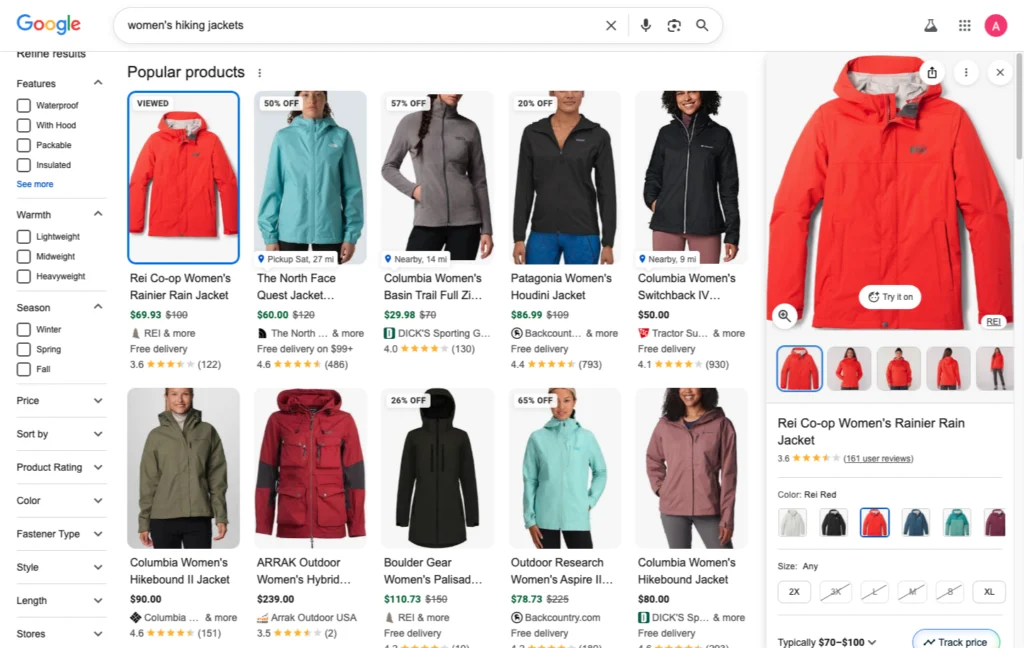
Internal Audience Key research conducted in April 2025 across 65,000 product-focused queries found:
- Roughly 90% of transactional searches triggered at least one organic product grid.
- About 63% showed three or more unique grids on the same results page.
When that happens, half — sometimes more — of the organic page is occupied before a standard category page even has a chance to earn attention.
Placement inside these grids is not random. It’s driven by signals that help Google understand what a product is, what category it belongs to, and how confidently that category is defined.
This is where ecommerce SEO quietly changed.
Keyword usage still matters. Content still matters. But neither works well without a clear, layered system that explains how everything fits together.
Why Taxonomy Has Become a Ranking Constraint
In ecommerce SEO, taxonomy is the structured way products and categories are organized and related so search engines and AI systems can understand what belongs together and why.
It is often treated as a navigation decision or a UX concern. In search systems, it’s something else entirely.
Taxonomy defines meaning.
A layered category structure tells search engines:
- What the primary theme is
- How sub-themes relate to that theme
- Which attributes refine intent rather than compete with it
When products live inside clear parent → child → sub-child relationships, several things happen at once:
- Topical relevance concentrates instead of fragmenting
- Internal links reinforce meaning instead of scattering it
- Schema has context at every level, not just at the product
- Products gain multiple discovery paths tied to real search behavior
This is especially important for grids and AI shopping experiences, where systems are deciding which products belong together before ranking even begins.
Flat structures don’t fail because they’re wrong. They fail because they’re ambiguous.
And ambiguity is poison for systems that rely on classification.
Where Shopify’s Model Starts to Break Down
Shopify’s collection system is intentionally simple:
- Collections exist at a single level
- There is no native concept of true sub-categories
- Hierarchy is implied through tagging, not enforced through structure
As a result, stores end up with dozens — sometimes hundreds — of collections that sit side by side with no formal relationship between them.
From a human perspective, that may feel organized enough. From a machine’s perspective, it’s not.
When “hiking jackets,” “winter jackets,” and “men’s jackets” all exist as separate, unrelated collections, search systems cannot reliably infer:
- Which is the parent theme
- Which is a refinement
- Which attributes should stack together
That uncertainty limits how confidently products can be grouped, categorized, and surfaced — especially in environments where grids and AI summaries do the sorting before a user ever clicks.
This is not a merchant failure. It’s a platform constraint.
And it’s the reason many Shopify stores plateau in organic visibility despite solid products, clean content, and strong technical hygiene.
What Flat Taxonomy Looks Like in the Real World
Most Shopify stores do not look disorganized on the surface. Navigation works. Filters exist. Products are reachable. The problem is not usability. The problem is meaning.
Here’s a simplified version of a structure we see constantly for apparel brands selling jackets:
Common Shopify collection setup
/collections/mens-jackets

/collections/womens-jackets

/collections/hiking-jackets

/collections/rain-snow-jackets

/collections/winter-snow-jackets

/collections/synthetic-puffer-jackets-vests
Each collection makes sense on its own. The issue is that none of them are formally connected to each other.
From a search system’s point of view, these are not refinements of a shared concept. They are parallel endpoints.
There is no declared parent category for “jackets.”
There is no structural relationship between gender and style.
There is no way to tell whether “hiking jackets” is a subset of men’s jackets, women’s jackets, or both.
All of that context is left to inference.
What a Layered Taxonomy Communicates Instead
Now compare that to how the same catalog would be expressed in a true hierarchical system:
/category/jackets

/category/jackets/mens

/category/jackets/mens/hiking

/category/jackets/mens/rain-snow

/category/jackets/mens/winter

/category/jackets/womens

/category/jackets/womens/hiking

/category/jackets/womens/rain-snow

/category/jackets/womens/winter
This structure does not just organize products. It explains them.
Search systems can now see “jackets” as the core theme, gender as a first-level refinement, and use case and insulation type as secondary refinements.


That clarity compounds across internal links, breadcrumbs, schema, and crawl paths. Products inherit context instead of standing alone.
A women’s hiking jacket is no longer just a product in a mixed collection. It is part of a defined category lineage that reinforces exactly what it is and where it belongs.
Why Flat Collections Create Ranking Friction
When everything sits at one level, several problems appear that are easy to miss if you only look at pages individually.
First, relevance gets diluted.
“Jackets” never fully accumulates authority because it is never treated as a parent concept. Each variation competes as a separate idea instead of strengthening a shared theme.
Second, internal linking loses direction.
Links exist, but they do not reinforce hierarchy. Products point sideways instead of up and down a structure that concentrates meaning.
Third, attributes blur into categories.
Style, gender, insulation, and use case all become separate collections. Search systems struggle to tell which distinctions matter most.
Fourth, scalability breaks down.
As new styles are added, collections multiply. The site grows wider, not deeper. Each addition increases ambiguity instead of resolution.
None of these issues show up in a crawl report or a page-level audit. They surface when products fail to appear in grids, when categories stall, and when competitors with clearer structure keep winning visibility.
Why This Matters Beyond Traditional Search
This structural ambiguity does not only affect rankings. It affects interpretation. Product grids rely on confident grouping. AI shopping assistants rely on contextual clarity. Both perform better when category relationships are explicit rather than implied.
Here’s an example:
A product labeled “hiking jacket” without a defined place inside a broader category system forces machines to guess. A product labeled “jackets → women’s → hiking” does not.
That difference becomes more important as discovery shifts away from lists of links and toward systems that group, summarize, and recommend before a click ever happens.
The Constraint Is Architectural, Not Tactical
It is tempting to treat this as a collection naming problem or a tagging problem. It is neither.
Shopify does not support true multi-level category hierarchies in its native URL and collection system. That limitation caps how clearly meaning can be expressed, regardless of how strong the products or content may be.
This is why many Shopify stores reach a point where incremental SEO work stops producing incremental gains. The ceiling is not effort or quality. It is structure.
The next question becomes unavoidable:
If the platform cannot express layered taxonomy on its own, where does that structure get added?
That is where Edge SEO enters the conversation.
Where Edge SEO Fits Into the Picture
Once you accept that the limitation is structural, the solution stops being a checklist item.
❌ You cannot fix a missing hierarchy with better titles.
❌ You cannot fix it with more copy.
❌ You cannot fix it by rearranging collections inside the same flat system.
The structure has to exist somewhere.
Edge SEO works because it introduces that structure outside of Shopify, not inside it.
What “Edge SEO” Actually Means in Practice
Edge SEO refers to changes made at the content delivery layer, after Shopify generates a page but before that page is delivered to a crawler or a user.
In practical terms, the flow looks like this:
- Shopify outputs its standard HTML.
- The request passes through the CDN (content delivery network).
- SEO-specific logic modifies the page in transit.
- The final HTML is served as a single, complete document.
To Google, this looks like one normal page. To Shopify, nothing has changed. To the site owner, structure has been added without touching the platform.
This is not cloaking. The same HTML is served to users and crawlers. The difference is where the assembly happens.
Why the Edge Solves Shopify’s Taxonomy Ceiling
Because the edge sits outside the CMS, it is not bound by Shopify’s collection model.
That means you can:
- Present multi-level category paths that do not exist natively.
- Define parent and child relationships in URLs and breadcrumbs.
- Create internal linking patterns that reinforce hierarchy.
- Add category-level schema that reflects layered meaning.
All of this happens without rebuilding templates, duplicating collections, or forcing tags to behave like categories.
From a search system’s perspective, the site suddenly has depth.
From Shopify’s perspective, it is still doing exactly what it has always done.
Structure Without Replatforming
This distinction matters because replatforming is rarely the real problem.
Most Shopify stores do not need a different ecommerce engine. They need a way to express meaning more clearly than the platform allows by default.
Edge SEO fills that gap by acting as a translation layer. It takes a flat source and presents it as a structured destination.
That structure then feeds directly into the systems that now control discovery:
- Product grids that rely on confident categorization
- Ranking systems that reward clear topical grouping
- AI shopping assistants that need explicit context
None of those systems care how the structure was created. They only care that it exists.
Where Audience Edge Fits
This is where Audience Key’s edge system enters the picture.
Audience Edge operates at the CDN layer, commonly through platforms like Cloudflare, and is designed specifically to solve the structural problems Shopify introduces.
It allows teams to:
- Simulate layered taxonomy on top of flat collections
- Automate internal links that reinforce category relationships
- Inject schema that reflects hierarchy rather than guesswork
The important point is not the tooling. It is the approach.
Once structure is added at the edge, Shopify stops being the constraint it once was.
Why This Also Changes AI Visibility
Search engines are not the only systems interpreting your catalog anymore.
Large language models and AI shopping assistants rely heavily on structure to determine relevance and confidence. They do not crawl like browsers. They summarize, group, and infer.
A product that lives inside a clearly defined category path is easier to understand than one that exists in isolation.
- Layered taxonomy reduces ambiguity.
- Internal links reinforce associations.
- Schema makes those associations explicit.
The same structure that helps products appear in grids today helps AI systems describe, compare, and recommend them tomorrow.
Flat systems force machines to guess. Structured systems give them answers.
The Takeaway So Far
Shopify’s flat taxonomy is not a flaw. It is a tradeoff. Simplicity was prioritized over expressiveness.
Edge SEO restores expressiveness without giving up the platform benefits that made Shopify attractive in the first place.
Once structure is no longer the bottleneck, SEO effort compounds again. Categories reinforce each other. Products inherit context. Discovery improves across both search and AI-driven surfaces.
The real constraint was never effort or execution. It was whether the underlying structure could keep expressing what the store had already become.