“The goal of effective communication should be for listeners to say ‘Me too!’ versus ‘So what?”
— Jim Rohn
It’s 2026. Why are we still talking about keyword mapping? It feels so 2016.
Fair question. Search changed. The practice evolved.
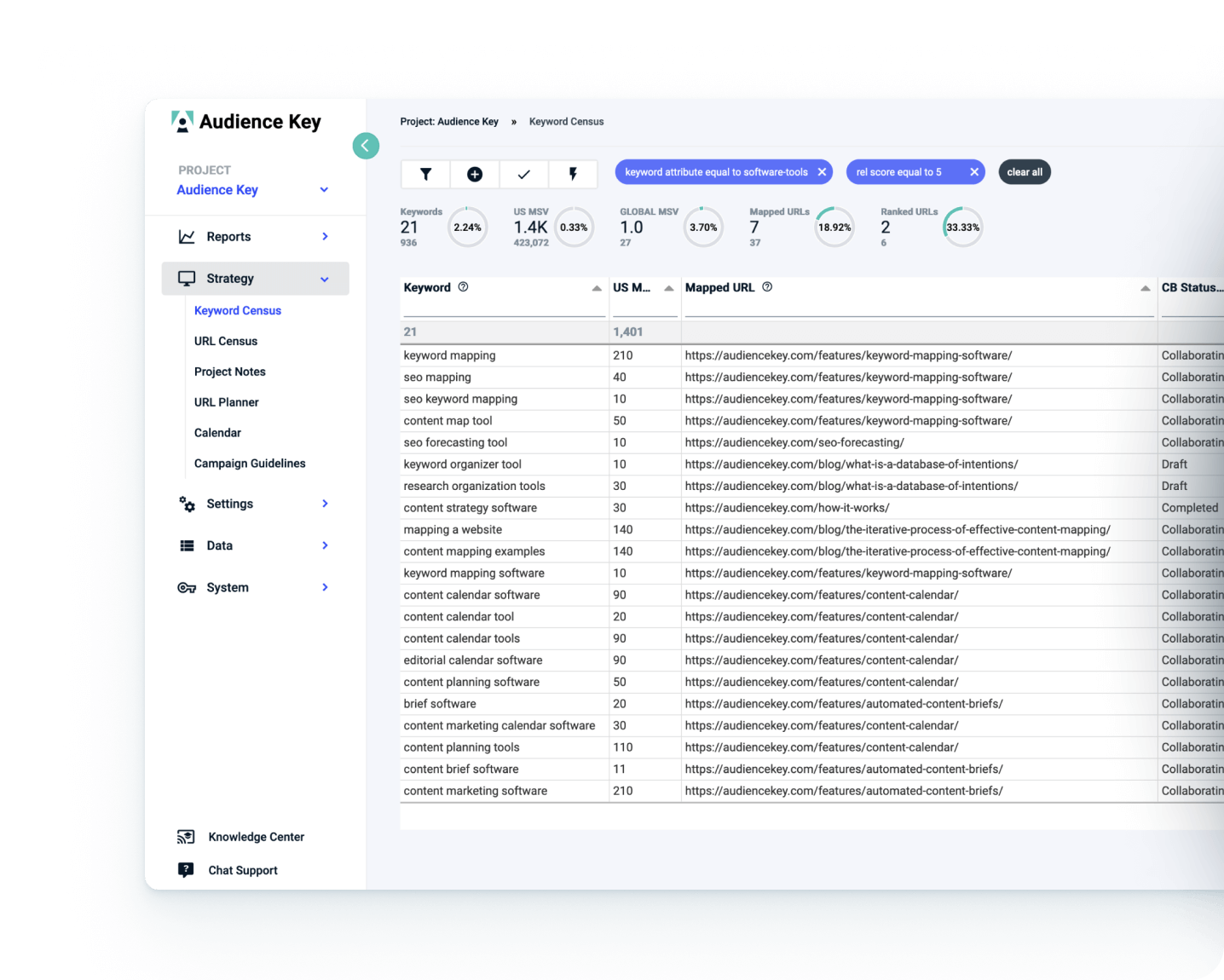
Keyword mapping is the strategic process of aligning target keywords with specific URLs to organize content, prevent internal competition, and maximize search visibility. In today’s search landscape, powered by BERT, E-E-A-T guidelines, and AI-driven results, keyword strategy remains essential but has shifted toward intelligent concept organization.
Modern keyword mapping focuses less on individual keywords and more on the concepts they represent. When you align keywords with specific URLs, you’re organizing the core concepts important to your pages and site as a whole, maximizing both SEO (Search Engine Optimization) and AEO (Answer Engine Optimization) performance.
Why Keyword Mapping Matters for SEO and AEO
SEO is familiar. AEO is the newer sibling with several competing names and no agreed-upon acronym yet. Call it answer engine optimization, generative optimization (GEO), large language model optimization (LLMO), language model findability and answer optimization (LMFAO, my personal favorite :D), or something else entirely — the point is that search systems now choose answers, not just pages.
Keyword mapping has evolved into an exercise in organizing the concepts that matter most to your target audience. Keywords represent concepts you’re vying for, so mapping them to specific pages creates a cohesive, well-planned content strategy.
Key Benefits of Keyword Mapping
Improves audience targeting
Keyword mapping enables you to target distinct concepts on your website pages effectively. This reduces the risk of multiple pages competing for the same audience (keyword cannibalization), which can dilute ranking potential. Proper mapping prevents overlap and helps search engines and AI bots understand the relevance of each page to user queries.
Enhances content organization
Creating a logical site structure by associating specific keywords with specific pages helps search engines and users navigate your site more easily. A well-mapped keyword strategy enhances content relevance, making it clear what each page addresses and what search intent it fulfills.
Optimizes on-page SEO
Keyword mapping aligns all on-page SEO elements including titles, meta descriptions, headers, and body text with target keywords for each page. This strategic alignment boosts the chances of pages ranking higher for their intended keywords.
Improves user experience
When pages are conceptually optimized to align with user intent, visitors are more likely to find what they’re looking for. This not only improves rankings but also provides a better experience, increasing user engagement and conversions.
Enables performance tracking
With a clear keyword mapping plan, you can track how each page performs in terms of keyword rankings. This makes it simpler to analyze what’s working and what needs improvement, helping identify gaps and opportunities.
Reveals content gaps and opportunities
Keyword mapping helps identify content gaps where certain topics or keywords may not be fully covered by existing pages. It provides insight into which pages need more content or additional optimization, ensuring you don’t miss important search traffic and opportunities to overtake competitors.
How to Create a Keyword/Concept Map: Step-by-Step Guide
Understanding Your Keyword Data
Begin by recognizing the value of your keyword list and the supporting data. Search engines and SEO platforms function as massive datasets of user intent. By analyzing keyword metrics, you’re decoding the psychology of your audience. This data reveals which concepts resonate most with your customers, providing a blueprint for effective communication.
The 4 Pillars of Search Data
Monthly search volume (MSV): Measures the broad popularity and market demand for specific concepts. Higher search volume indicates greater interest and potential traffic.
Cost per click (CPC): Signals the commercial intent and monetary value of a term within the marketplace. Higher CPC often indicates stronger buyer intent and competitive value.
Keyword competitiveness (difficulty): Reflects the density of the competitive landscape and the effort required to earn share of voice. This helps you prioritize winnable opportunities.
Current site rankings: Your current rankings reflect how relevant search engines consider your site for specific topics.
Core Insight: Audience search behavior is audience behavior. Every search query is a data point of desire. As a marketer, this allows you to move beyond guessing and start designing customer experiences around proven needs.
5 Steps to Execute Keyword Mapping
Keyword mapping is the process of assigning specific keywords to relevant pages on your website. This ensures that every piece of content has a clear purpose and meets a specific audience need.
Step 1: Score Keywords for Business Relevance
Before mapping, prioritize your keywords. Assign each keyword a relevance score on a scale of 1 to 5, with 5 being the most valuable to your business goals.
This score is internal. It has no direct impact on search rankings. Its job is communication among SEO, content, product and leadership teams about what matters most. It separates mission-critical keywords from those that are simply nice to have.
Adding a relevance score bridges the gap between raw data and actual strategy. It forces you to look past raw keyword data like MSV or competitiveness and focus on what moves the needle for your business. A high-volume keyword with a low relevance score is often a distraction, while a low-volume keyword with a relevance score of 5 is a gold mine, likely leading to direct conversions.
Step 2: Group Keywords by Semantic Intent
Instead of looking at keywords in isolation, group them into topic clusters. This helps search engines understand the breadth of your expertise and allows large language models (LLMs) to categorize your site as an authority on specific subjects.
Grouping methods:
- Synonyms and antonyms: Put words with similar meanings together (cost and price) or opposite meanings (cheap and expensive). This reveals the language choices of your audience and how your content can reflect that.
- Funnel stage: Keywords can reveal whether a user is a marketing qualified lead (MQL) or sales qualified lead (SQL). Delineating between transactional versus informational queries helps tailor content to user intent.
- Thematic categories: Organize words around a central theme. Keywords with specific modifiers like “best” or “most” are all centered around finding the optimal option.
- Function: Group words based on their grammatical function, like nouns, verbs, adjectives, or adverbs. Look for commonalities in words being searched for, such as sizes, qualities, pricing, or use cases.
Step 3: Match Clusters to the Customer Journey
Determine where each keyword fits in the marketing funnel. Is the user seeking information (awareness), comparing options (consideration), or ready to take action (decision)?
- Awareness stage: Broad keywords and general informational queries
- Consideration stage: Keywords associated with planning, comparisons, and questions
- Decision stage: Buying queries related to price, specific product details, and transactional intent
Step 4: Assign Keywords and Concepts to Target URLs
Each page should have one primary concept it owns. Represent that by mapping a focus keyword (or a few closely tied to the concept) to each page, along with related secondary terms that support the intent. In this example both “landscape lighting” and “landscape lights” are both mapped as the primary concept because Google (and other search engines) recognize “lighting” and “lights” synonymously.
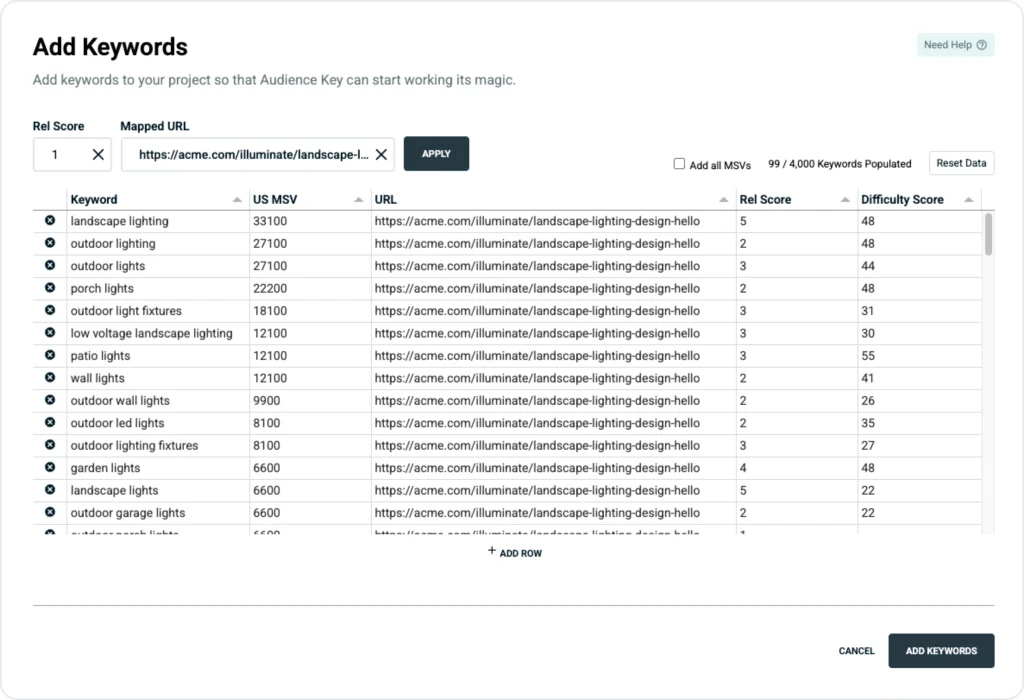
This creates a cohesive content architecture telling search engines and AI bots what each page is about. Keywords that don’t clearly support a page’s purpose should stay unassigned until a better home exists. That restraint is what prevents bloated pages, muddled intent, and internal competition.
Step 5: Audit and Fill Content Gaps
Keyword mapping is an ongoing process, so after the first iteration, it’s time to audit your work and adjust your strategy. This is a two-stage process:
- Review existing mapping: Examine keywords and concepts you’ve assigned to pages for topic and business relevance and how they may or may not be performing in search.
- Identify gaps: Determine which high-value keywords (those you scored as 4s and 5s) lack a dedicated home on your site so you can create a content plan to fill these gaps, ensuring your audience finds the answers they’re looking for.
Core Insight: Keyword mapping is an essential part of a successful content strategy because it provides structure, improves targeting, and ensures content is aligned with both user intent and search engine guidelines. When done properly, it increases the visibility and relevance of each page, driving more targeted traffic to your site.
11 Use Cases for Keyword Mapping
Why invest time in keyword research? Why collect, organize, and map keywords before writing content? The answer lies in strategic planning and measurable results.
Keyword mapping offers important advantages: It enables you to plan content strategically and measure results effectively. By assigning keywords to specific pages, you add a strategic layer benefiting every marketing funnel page. Here’s how:
Benefit 1: Improve Audience Targeting
Identify what’s important to your audience and focus your content strategy.
Use Case 1: Product page optimizations
Map keywords to product pages to inform messaging strategy and set performance benchmarks. Optimize conversion-focused pages while deoptimizing less critical ones for specific terms. This creates a direct path to revenue growth by ensuring your most valuable pages rank for your most valuable keywords.
Use Case 2: Content pruning and deoptimization
Mapping forces you to pick winners when content bloat creates five functionally identical pages competing for attention. Eliminate pages adding no unique keyword value, redirect traffic to stronger pages, and deoptimize low-business-value content diluting your site’s focus.
Benefit 2: Enhance Content Organization
Well-organized content is good for users and the bots that crawl and ingest your content.
Use Case 3: Easier metadata optimization
Title tags, meta descriptions, and H1 headers inform users and bots of page intent at a glance. Strategic mapping clarifies each page’s purpose, preventing metadata overlap that confuses search engines or leaves relevant terms untargeted. Clear metadata helps both ranking and click-through rates.
Use Case 4: Internal linking optimization
Mapped keywords reveal natural connections between pages. Sort by keyword or topic to identify all pages that should link together, improving user experience, helping bots understand content relationships, and keeping users engaged on your site longer.
Benefit 3: Optimizes On-Page SEO
Align all on-page SEO elements including titles, meta descriptions, headers, and body text with target keywords for each page.
Use Case 5: Create FAQs that matter
Build better FAQs by knowing what your audience values at each stage in the purchase funnel and identifying gaps where queries don’t match existing content. Does your audience care more about features or pricing? Keyword research answers that question with data.
Use Case 6: Compose authoritative long-form content
Detailed keyword research reveals the vocabulary your audience uses when seeking expertise. Map these keywords to guide content depth. If one feature has 10 times more keyword variations, it deserves proportionally more coverage in your content.
Benefit 4: Improves User Experience
Strategically optimizing pages for semantic intent ensures that both search algorithms and human visitors recognize your content as the most relevant answer to their query.
Use Case 7: Write effective top-of-funnel content
Resources, blogs, and social posts catch people early, before they’re ready to buy. Place research-related keywords that don’t belong on product or category pages into educational content instead, so you show up sooner and stay visible longer throughout the buyer journey.
Benefit 5: Enables Tracking and Measuring Success
Keyword mapping turns raw search data into a diagnostic roadmap, making it easy to track what’s working and prioritize content needing optimization.
Use Case 8: Strategy and content auditing
Revamping existing content? Keyword mapping provides baseline numbers and clear goals. Define targeting upfront to compare performance accurately when evaluating success. This creates accountability through the rankings and shows ROI for content investments.
Use Case 9: Prove your content strategy worked (or didn’t)
Keyword mapping tells a compelling story to stakeholders: You mapped this keyword to this page, created focused content around audience intent, and now search engines deliver qualified traffic — or not, which is not necessarily a failure but valuable information about your audience. Both are measurable success stories.
Benefit 6: Reveals Content Gaps and Opportunities
By revealing untapped topical gaps, keyword mapping allows you to refine your content strategy and reclaim market share from the competition.
Use Case 10: Combine PPC and organic search efforts
Share mapped keyword lists with organic traffic and ranking data between teams. Identify where PPC (pay-per-click) advertising should build on organic success or compensate for weaknesses. This integrated approach maximizes ROI across channels.
Use Case 11: Turn a content section into a single page (or vice versa)
When you consolidate multiple pages into one (or split a single page into sections), keyword mapping ensures each URL targets distinct search intents. Without it, you risk creating competing pages that dilute your rankings. Consolidating pages prevents accidental duplication of concepts/content and ensures that search engines understand which page should rank for each query.
Core Insight: Keyword mapping transforms keywords from isolated search terms into a strategic framework touching every aspect of digital marketing—from content creation and site architecture to paid advertising and performance measurement. The real power isn’t in the keywords themselves, but in how mapping them reveals the hidden connections, gaps, and opportunities across your entire digital ecosystem.
Conclusion: Keyword/Concept Mapping as Strategic Foundation
Keyword mapping transforms scattered keyword research into a strategic content framework. By aligning keywords with specific URLs, you create a clear roadmap for content creation, optimization, and measurement that serves search engines, AI-bots, and users. In the age of AI-driven search and evolving algorithms, keyword mapping remains a fundamental practice for any organization serious about organic visibility and sustainable traffic growth.